Showing posts with label fun stuff. Show all posts
Showing posts with label fun stuff. Show all posts
Tuesday, September 25, 2007
Get your NaNo engines in gear
The National Novel Writing Month forums just closed for renovations prior to the October 1 opening date for registration. NaNo addicts like me are waiting with fingers poised over the keyboard, ready for NaNo pre-plotting during October, and the race to 50,000 words in November. If you've never tried it and always wanted to, how about this year?


Tuesday, July 18, 2006
Movie Cliches
Our household subscription to Netflix brings a regular round of digital video entertainment to suit our eclectic tastes. What, I wonder, can be said about a couple who enjoy Jane Austen movies, samurai movies, film noir, Buster Keaton, and the entire Hercule Poirot series?
Yet in movie after movie, the same cliches turn up with tiresome regularity. Maybe it's just the storyteller formula showing up. But I'm sure you all recognize these movie cliches, and can list more that I've missed:
Yet in movie after movie, the same cliches turn up with tiresome regularity. Maybe it's just the storyteller formula showing up. But I'm sure you all recognize these movie cliches, and can list more that I've missed:
- Spaceships are always fully-armed, make a rumbling noise in space as they travel, and their weaponry causes audible explosions.
- A thousand bad guys, armed to the teeth, firing rapid-fire automatic weapons at the good guy, can't hit him even though he's running across a mile of open ground, dressed in street clothes or formal attire. However, the good guy can hit any bad guy he chooses, even while running in formal attire across open ground with a thousand bad guys firing at him.
- When the villain runs out of bullets in his revolver, he will click the trigger three times, then throw the revolver.
- When running away from a speeding car, rolling giant boulder, or similar oncoming danger, people always run directly in front of it instead of darting to the side to get away.
- Even in nylons, a dress, and high-heels, the heroine can outrun the bad guys, and can usually out-gun them.
- At the point of death, the dying person always has breath enough to gasp a coherent conversation, then collapses peacefully. If about to name his or her attacker, the dying person collapses mid-sentence. The hero/heroine then gently closes the person's eyes.
- A highly-competent detective can't solve the biggest crime of his career until his boss fires him for obsessing over it -- then he goes all-out to hunt down the villain.
- Only bad-guys play cruel tricks on people, shoot innocent people, or use booby-traps -- and good guys only do those things to bad guys.
- In a mystery, the non-main-character who claims to know who the murderer is, but has a few more facts to check before announcing the name, will die in the next scene.
- Native Americans, Australian Aborigines, and similar indigenous groups in modern movies are always wise, possess mystic powers, and can commune with nature. In modern movies, they are as invariably the good guys as in old films the are invariably either the bad guys or the comic relief.
- In family films, men are clownish, women are much smarter than men, and children are much smarter than either parent, as well as being smart-mouthed and highly technologically competent.
- Plain girls always wear their hair in a bun and wear glasses. As soon as they take off their glasses and let their hair down, they're gorgeous.
- In a scary movie, whenever there is a door that should not be opened, a room that should not be entered, or a cave, cellar, or tomb emitting odd noises that would cause rational persons to turn away, a minor character will always enter, and will be killed.
- Cars involved in accidents explode violently -- except in comic action movies, where car chase scenes involve smashing dozens of cars, but without a single fatality.
- A main character, when pursued by villains, will all too often go up some tall structure, where he is forced to fight the bad guys at dizzying heights. Was he expecting to out-climb them? Or to find an escape route at the top?
- If there is some huge, whirring, grinding machine in an action film, someone will end up falling into it -- and if the villain deliberately feeds an innocent victim into the machine early in the movie, he will surely die the same way by the end.
- When main characters defuse a bomb, it will always have a digital timer that will always stop at the last possible second.
- Computers are always operated by typing on a keyboard, which always makes a clacking sound. Hollywood does not seem to have heard of the mouse.
- Characters who announce they are looking forward to retirement, their 50th anniversary, or similar long-awaited celebration will either die or have the celebration disrupted.
- No meal that the main characters sit down to is never finished.
- When the villain captures the hero, rather than simply shoot him in the head and get it over with, the villain admits his guilt, tells the whole story, then sets in motion an elaborate device to kill the hero, and walks away, allowing the hero time to escape and time for any of the hero's allies to arrive.
- People in all cultures speak English. If the movie is a period piece, they speak English with one or more British accents. All except henchmen, who speak in some vague accent that could be Russian, Arabic, or a blend of both.
- Ventilation shafts are always large enough to accommodate adult humans, are clean, and always go where the hero needs to go.
- A blow to the head with a heavy object knocks a main character out, yet they always recover with no skull fracture and no brain damage. Not even a concussion. If the person knocked over the head is an unnamed guard, they will always fall unconscious for any length of time convenient for the hero.
- If a lead man and lead woman fight and bicker in the first half hour of the movie, they will fall in love or fall in bed (not necessarily in that order) before the end.
- All evil villains have henchmen who obey their every command without question. Most of the henchmen don't have names or speaking parts.
- In action movies, the hero and villain will meet face-to-face for hand-to-hand combat.
- A female character, when being chased, will keep looking over her shoulder to see how close the bad guys are, even though it obviously slows her down.
- No matter how far the good guy falls, no matter how hard of a blow he takes, no matter how hard he is kicked, he'll still won't die soon after from massive internal bleeding. If the fight is late in the movie, he will rise up, and find the strength to pummel his opponents into the dust.
- When the villain cuts the phone line, cutting off the hero or heroine who is calling for help, the telephone will more often than not emit a dial tone. And of course the character doesn't carry a cell phone.
- Regardless of what damage the hero does to public places and no matter how many traffic laws and laws about discharge of firearms he breaks, he will never be arrested for these. If he is arrested, it will be on trumped-up charges arranged by the villain.
Wednesday, July 05, 2006
English Lessons
If you haven't seen this bit of internet lore, that used to be photocopy lore, that used to be ditto sheet lore, here again in all its glory:
Rules for Writing
Rules for Writing
- Verbs HAS to agree with their subjects.
- Prepositions are not words to end sentences with.
- And don't start a sentence with a conjunction.
- It is wrong to ever split an infinitive.
- Avoid cliches like the plague. (They're old hat)
- Also, always avoid annoying alliteration.
- Be more or less specific.
- Parenthetical remarks (however relevant) are (usually) unnecessary.
- Also too, never, ever use repetitive redundancies.
- No sentence fragments.
- Contractions aren't necessary and shouldn't be used.
- Foreign words and phrases are not apropos.
- Do not be redundant; do not use more words than necessary; it's highly superfluous.
- One should NEVER generalize.
- Comparisons are as bad as cliches.
- Eschew ampersands & abbreviations, etc.
- One-word sentences? Eliminate.
- Analogies in writing are like feathers on a snake.
- The passive voice is to be ignored.
- Eliminate commas, that are, not necessary. Parenthetical words however should be enclosed in commas.
- Never use a big word when a diminutive one would suffice.
- Use words correctly, irregardless of how others use them.
- Understatement is always the absolute best way to put forth earth-shaking ideas.
- Eliminate quotations. As Ralph Waldo Emerson said, "I hate quotations. Tell me what you know."
- If you've heard it once, you've heard it a thousand times: Resist hyperbole; not one writer in a million can use it correctly.
- Puns are for children, not groan readers.
- Go around the barn at high noon to avoid colloquialisms.
- Even IF a mixed metaphor sings, it should be derailed.
- Who needs rhetorical questions?
- Exaggeration is a billion times worse than understatement.
- Proofread carefully to see if you any words out.
Wednesday, June 14, 2006
Wouldn't these make great writing prompt pictures?
Check out this blog post: Seamless Pictures. Shades of Escher, but in color and... well, you just have to see.
I've used pictures from The Mysteries of Harris Burdick by the amazing illustrator Christopher van Allsburg (of Jumanji and Polar Express fame) with kids as picture writing prompts. In a summer writing session, we challenged kids to come up with captions for the pictures. Young kids, literal as ever, gave them some very straighforward captions such as, "A nun is sitting an a floating chair." After we read the text that goes with the pictures, a few of them started to get the idea that the caption and the picture together can tell a story.
I can see Seamless Pictures being used in the same way, either to come up with interesting captions (which are in themselves one-line stories), or as prompts to create surreal stories. Give them a try and see what you come up with.
I've used pictures from The Mysteries of Harris Burdick by the amazing illustrator Christopher van Allsburg (of Jumanji and Polar Express fame) with kids as picture writing prompts. In a summer writing session, we challenged kids to come up with captions for the pictures. Young kids, literal as ever, gave them some very straighforward captions such as, "A nun is sitting an a floating chair." After we read the text that goes with the pictures, a few of them started to get the idea that the caption and the picture together can tell a story.
I can see Seamless Pictures being used in the same way, either to come up with interesting captions (which are in themselves one-line stories), or as prompts to create surreal stories. Give them a try and see what you come up with.
Thursday, May 25, 2006
Free Writing Courses at Barnes & Noble University
Barnes & Noble just announced the latest courses from Barnes & Noble University. Among the offerings are:
- The Art of the Short Story with Gotham Writers' Workshop
- Writing Mysteries with Writers' Digest Books
- Writing Science Fiction with Gotham Writer's Workshop
- Thinking Like an Editor: How to Get Published
- Grammar Fitness
All these courses are free and take place entirely online. Here's how it works:
You register for the course, and get access to the message board for that course. There is usually a book that you should purchase for the course, which, naturally, Barnes & Noble is happy to help you order. The instructor posts readings on the course message board, and makes assignments. Students respond to the assignment by posting their writing on the board. Instructors and fellow students may comment on the posts.
Most courses last four weeks, with two lessons per week. Following through requires some committment on the part of the student, but four weeks isn't a tremendous amount of time out of most people's lives.
Besides, free is a very good price.
Saturday, April 01, 2006
Stephen King's Little Pink Secret
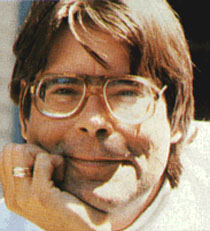 The secret is out. Though he's denied it for almost three decades, horror author Stephen King at last admitted that he began his writing career as a closet romance writer, writing under the pen name of Regina Stephens for the now-defunct Sweptwinds books, a former subsidiary of Reilly & Lee.
"I don't know why this should shock anyone," Mr. King said, in an interview given only to local reporters. "Lots of science fiction and horror writers supported themselves early on in their careers by writing porn stories for the men's magazines. I found that market was already too crowded, so I went for what you might call soft porn, women's porn, which is really what the romance line is all about, even the stuff with no on-stage sex in it."
When asked how he chose his pen name, Mr. King responded, "Come on... Stephen King... Regina Stephens... think about it. It was such an obvious choice."
Mr. King also commented on how a writer with a penchant for dark horror managed to write for a line of sweet romance books. "At the time it wasn't hard to get ideas," he said. "I'd just watch the soaps for a few days -- which was as much as I could take of them -- and then start putting ideas together. Romance readers are a lot more savvy these days, but back then, you could still get away with formulaic romance. Once you had the general formula down, it wasn't hard to churn out book after book. I'll admit it wasn't my best writing. It wasn't very inspiring. But it paid the light bill and kept food in the fridge until my horror writing took off."
Mr. King kept his secret well. Even his autobiographical book On Writing
 (Scribner, 2000) makes no mention of his romance writing, in spite of many other confessions about his personal life.
Romance writer Doris Richards, author of over 60 category romances for various companies, was the first to blow the lid off of Stephen King's "Little Pink Secret," as she calls it. Richards read Carrie when it was first published in 1974. "I wondered at the time," Richards said. "I was a high school senior then, and everyone told me I was crazy. Carrie? Carrie was a horror novel, not a romance. But I was also an avid romance reader, and I could see traces of the familiar pattern of a gothic romance. There was the dejected daughter, the stern mother, the handsome boy... true, the dejected daughter was an unintelligent lump, but give her beauty instead, and you'd have the perfect setting for a gothic or a teen romance. Minus the pig's blood, of course!" Richards added with a laugh.
"I am actually a little surprised that no one else spotted that," Mr. King responded, with a wry smile, when reporters showed him the Richards interview. "I thought it would be a bit too obvious."
So was Carrie really a romance novel in disguise? Mr. King laughed. "Almost. It did start out as a teen romance. Sweptwinds was suffering from competition from the big names like Harlequin that were taking over the racks at the drug stores. That was where most of Sweptwinds' sales came from. And Harlequin had the subscription program while Sweptwinds didn't, so that really did them in. To boost sales they were going to try this new teen romance line. They asked me to write one of the lead books, but they had some definite ideas about what the books should be like. Instead of just letting me go, they handed me this plot outline and wanted me to fill it in.
"That was the beginning of the end of my career with Sweptwinds. I couldn't finish the damned thing! I hated Carrie. Hated her with a passion. Well, she wasn't "Carrie" then, she was "Carina," but I still couldn't stand her. She was a little princess. Another writer took over the story, and I quit the romance business. I wrote Carrie because I really wanted to kill that wretched Carina off. Then I thought, hey, why just kill her off? Why not turn her into an evil character and have her take down half the town with her? So that's how Carrie started. Imagine my surprise when it took off like a rocket."
And we're imagining your surprise when you check the date and realize this entire article is pure tripe. April fools!
Thursday, February 16, 2006
Ten Basic Rules
Whatever: Writing Tips for Non-Writers Who Don't Want to Work at Writing
I stumbled across this today. One can fairly hear the smack as the author writes with face-slapping force about the rules that ought to govern daily writing. The rules are simple and common-sense enough, yet one sees them violated daily on message boards and blogs. People are used to forgiving bad writing on message boards -- except, perhaps, boards for writers where one might expect the participants to be able to write -- but since an unreadable blog by the very definition is not going to get read, bloggers may want to take note.
I stumbled across this today. One can fairly hear the smack as the author writes with face-slapping force about the rules that ought to govern daily writing. The rules are simple and common-sense enough, yet one sees them violated daily on message boards and blogs. People are used to forgiving bad writing on message boards -- except, perhaps, boards for writers where one might expect the participants to be able to write -- but since an unreadable blog by the very definition is not going to get read, bloggers may want to take note.
Monday, February 13, 2006
An open letter to Dick Cheney
Dear Mr. Vice President:
The quail is the one with feathers.
Hope this helps.
Love 'n kisses,
Writerious
The quail is the one with feathers.
Hope this helps.
Love 'n kisses,
Writerious
Subscribe to:
Posts (Atom)


