The Making Light blog is spreading the word about a list compiled by Victoria Strauss of Writer Beware (on the Science Fiction and Fantasy Writers of America website). These are the 20 Worst Literary Agents about whom Writer Beware has received complaints. Before signing on with any agency, check out this list, or look up your potential agent on the Preditors and Editors website (yes, it's spelled that way, for alliterative purposes). "Preditors" is also a terrific resource for checking out publishers, contests, and any other venue where the scammers attempt to mingle with the legitimate businesses.
Be aware, be informed, and don't be too hasty to respond to those five wonderful words that the scammers use to lure the unsuspecting: "We want to publish you!"
Thursday, April 20, 2006


Friday, April 14, 2006
The Voiceless Speak through Writing
Article Link: Writing for - a change
In Pakistan, where women's literacy rates in rural areas run between 3 and 8%, a group of women is busy with something that some among their people would consider radical: they're writing.
In a free journalism course, a subject formerly reserved only for men, women write of their fears, their hopes, of "honor" killings that have taken the lives of friends and family members, of poverty, powerlesness, and childhood marriages that entrap young women before they have the chance for a life of their own.
In developing nations, education is often the path out of poverty, but education is limited for poor men and almost non-existent for women. In this patriarchal society, women write of the fear and anger that men display when confronted by the possibility that "their" women might become educated, might have a mind, a voice, a will, an opinion. It's a direct threat to the way of life. But so long as any group is marginalized to the point of silence and near non-human status, how can there be true freedom?
In Pakistan, where women's literacy rates in rural areas run between 3 and 8%, a group of women is busy with something that some among their people would consider radical: they're writing.
In a free journalism course, a subject formerly reserved only for men, women write of their fears, their hopes, of "honor" killings that have taken the lives of friends and family members, of poverty, powerlesness, and childhood marriages that entrap young women before they have the chance for a life of their own.
In developing nations, education is often the path out of poverty, but education is limited for poor men and almost non-existent for women. In this patriarchal society, women write of the fear and anger that men display when confronted by the possibility that "their" women might become educated, might have a mind, a voice, a will, an opinion. It's a direct threat to the way of life. But so long as any group is marginalized to the point of silence and near non-human status, how can there be true freedom?
How NOT to be a famous writer
Article Link: United Press International - NewsTrack - Student convicted in letter-writing hoax
There are two ways to become famous for your writing. First is to write something great that gets published and starts such a buzz that everyone talks about your work. Second is to write something really dumb that gets you in trouble.
A former student at Chicago's Trinity college did the latter. Because she was unhappy at the school and wanted her parents to let her leave, she wrote a series of threatening letters -- against herself. The letters caused a huge stir on campus and prompted the evacuation of Hispanic and African-American students.
The student must attend counseling, pay a large fine, and perform many hours of public service. Perhaps some assertiveness training and character building should have been part of the sentence.
There are two ways to become famous for your writing. First is to write something great that gets published and starts such a buzz that everyone talks about your work. Second is to write something really dumb that gets you in trouble.
A former student at Chicago's Trinity college did the latter. Because she was unhappy at the school and wanted her parents to let her leave, she wrote a series of threatening letters -- against herself. The letters caused a huge stir on campus and prompted the evacuation of Hispanic and African-American students.
The student must attend counseling, pay a large fine, and perform many hours of public service. Perhaps some assertiveness training and character building should have been part of the sentence.
Friday, April 07, 2006
Free Expression Preserved: Dan Brown is Off the Hook
Idea for 'Da Vinci Code' Was Not Stolen, Judge Says (link to the New York Times -- free registration required)
In a ruling today on the lawsuit raised against Dan Brown, Justice Peter Smith declared that Dan Brown did not steal the "central theme" of Holy Blood, Holy Grail from authors Michael Baigent, Richard Leigh when he wrote The Da Vinci Code
 . According to the New York Times article:
Excellent news for fiction writers, indeed. Can you imagine what the publishing world would be like if every writer of historical fiction were sued by the authors of their sources? Who could write a novelization of Abraham Lincoln's childhood for children's libraries if they risked being sued by Lincoln's biographers? Could Michael Crichton be sued by scientists because he "stole" their ideas about genetics when he wrote Jurassic Park? Will lawyers go after John Grisham because he used the "architecture" of their profession in his novels?
Baigent and Leigh have a case only if they wish to declare their book as fiction -- and given their slightly dubious sources, some have wondered if that might not be the case, at least in part. Brown did use their claim that Mary Magdalene was the true "Holy Grail" as the central element of the mystery that runs through The Da Vinci Code. But a concept does not make a plot, nor does it define the central theme of a work of nonfiction. It was one interesting almost-fact that Brown decided to make factual in his fictional world.
Perhaps the members of Monty Python should raise a lawsuit against Baigent and Leigh for writing a book about the Holy Grail. After all, the Monty Python team did film their farce, Monty Python and the Holy Grail, long before Baigent and Leigh wrote their book.
In a ruling today on the lawsuit raised against Dan Brown, Justice Peter Smith declared that Dan Brown did not steal the "central theme" of Holy Blood, Holy Grail
from authors Michael Baigent, Richard Leigh when he wrote The Da Vinci Code. According to the New York Times article:Justice Smith also added:
In issuing his opinion, Justice Peter Smith said Mr. Brown had indeed relied on the earlier work, "The Holy Blood and the Holy Grail," in writing a section of "The Da Vinci Code." But he said two of the authors of "Holy Blood," Michael Baigent and Richard Leigh, had failed in their effort to prove that Mr. Brown had stolen their "central theme" because they could not accurately state what that theme was.
"It would be quite wrong if fictional writers were to have their writings pored over in the way 'The Da Vinci Code' has been pored over in this case by authors of pretend historical books to make an allegation of infringement of copyright."
Excellent news for fiction writers, indeed. Can you imagine what the publishing world would be like if every writer of historical fiction were sued by the authors of their sources? Who could write a novelization of Abraham Lincoln's childhood for children's libraries if they risked being sued by Lincoln's biographers? Could Michael Crichton be sued by scientists because he "stole" their ideas about genetics when he wrote Jurassic Park? Will lawyers go after John Grisham because he used the "architecture" of their profession in his novels?
Baigent and Leigh have a case only if they wish to declare their book as fiction -- and given their slightly dubious sources, some have wondered if that might not be the case, at least in part. Brown did use their claim that Mary Magdalene was the true "Holy Grail" as the central element of the mystery that runs through The Da Vinci Code
. But a concept does not make a plot, nor does it define the central theme of a work of nonfiction. It was one interesting almost-fact that Brown decided to make factual in his fictional world.Perhaps the members of Monty Python should raise a lawsuit against Baigent and Leigh for writing a book about the Holy Grail. After all, the Monty Python team did film their farce, Monty Python and the Holy Grail, long before Baigent and Leigh wrote their book.
Monday, April 03, 2006
Vanity, thy name is AuthorHouse (and Dorrance and PublishAmerica and...)

I've not yet tried self-publishing. I thought about it at one time and did a thorough investigation. I have several books on self-publishing and book promotion on my reference shelves. I've interviewed people who have self-published. Out of all of this research came the decision that self-publishing wasn't right for me, not with the book I was considering and the time I had to dedicate to such a project.
But if I do ever self-publish, which might be my choice in the future with the right project, I already know what I'm not going to do. I'm not going to answer one of the advertisements in the backs of writing magazines for the vanity presses. You know the ones, those full-page color ads with glowing testimonials, and promises that you can be a published author for "only" several hundred dollars.
This article explains just a few reasons why: Publishing Basics… for the self publisher » Why can’t I make money with a POD Publisher? The only quibble I have with this author is that I'd like to preserve the distinction between POD (a technology) and vanity presses (a venue). I know the vanities are calling themselves "POD publishers," but those who know better need to help preserve the distinction.
If you really want to self-publish (and there are good reasons to do so with the right project), become your own publisher, because that's what "self-publishing" is. Find yourself a good printing service, find out how to get an ISBN number, hire an editor if you need one, and take total charge of your book. Learn how to run a small business, because publishing is a business. It may be just you and a few books, but to the IRS, it's a business. One place to begin your research is with Books Just Books, which has a highly educational website.
If you're not interested in marketing plans and the book business and just want to get copies of your books to family, friends, and a few fans, try a straightforward POD service such as CafePress or Lulu. (See why I want to preserve the distinction between PODs and vanities? Though I'm still not entirely clear which Lulu is.)
I wouldn't have an argument with the vanities if they were honest about what they do. But all too often, they're not. They tell you what a success you could be, not what you'll probably be, considering the quality of most vanity-published books (and I don't mean just the writing), the book market as it is today, and your chances of getting distributors and bookstores to carry your books. They make glowing promises and deliver little. In the bad old days before POD (print on demand) technology, they'd deliver a several cases of books with no marketing support. I've met many authors who still have boxes of books moldering away in their basements, books they can't even give away, books they keep threatening to burn for fuel in the winter. Now with POD technology, you don't even get that much.
Though I try to bite my tongue, I can't help but get irritated with people who send their books off to vanities, they run around counseling others to do the same, gushing about "how easy it is to get published!" It's a little like running into someone who won a handful of cash from a slot machine and is now running around telling everyone that "playing the slots is a great investment! It's so easy to make money!" A few -- very few, exceptionally few -- have managed to make some money with the vanities. But those rare exceptions have a responsibility to inform others that they are, indeed, exceptions, and that most people won't have success anywhere near what they experienced.
Sunday, April 02, 2006
Better Brains Through Sleep
Not getting enough sleep? Strategies to keep from getting dumb and fat - The Boston Globe
A while back I reviewed the book Sleep Thieves (Feb 13: Sleep Deprivation). Now the Boston Globe adds another reason for writers to get their sleep instead of burning the midnight oil to get just a few more pages done on that novel: sleep deprivation makes you dumb and fat!
So all you people who like to sleep in, just tell your parents, boss, or significant other, "Hey, I'm not lazy, I'm getting svelte and intelligent!"
A while back I reviewed the book Sleep Thieves (Feb 13: Sleep Deprivation). Now the Boston Globe adds another reason for writers to get their sleep instead of burning the midnight oil to get just a few more pages done on that novel: sleep deprivation makes you dumb and fat!
So all you people who like to sleep in, just tell your parents, boss, or significant other, "Hey, I'm not lazy, I'm getting svelte and intelligent!"
Saturday, April 01, 2006
Stephen King's Little Pink Secret
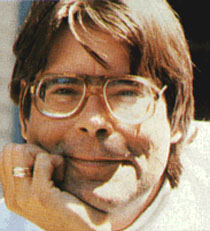 The secret is out. Though he's denied it for almost three decades, horror author Stephen King at last admitted that he began his writing career as a closet romance writer, writing under the pen name of Regina Stephens for the now-defunct Sweptwinds books, a former subsidiary of Reilly & Lee.
"I don't know why this should shock anyone," Mr. King said, in an interview given only to local reporters. "Lots of science fiction and horror writers supported themselves early on in their careers by writing porn stories for the men's magazines. I found that market was already too crowded, so I went for what you might call soft porn, women's porn, which is really what the romance line is all about, even the stuff with no on-stage sex in it."
When asked how he chose his pen name, Mr. King responded, "Come on... Stephen King... Regina Stephens... think about it. It was such an obvious choice."
Mr. King also commented on how a writer with a penchant for dark horror managed to write for a line of sweet romance books. "At the time it wasn't hard to get ideas," he said. "I'd just watch the soaps for a few days -- which was as much as I could take of them -- and then start putting ideas together. Romance readers are a lot more savvy these days, but back then, you could still get away with formulaic romance. Once you had the general formula down, it wasn't hard to churn out book after book. I'll admit it wasn't my best writing. It wasn't very inspiring. But it paid the light bill and kept food in the fridge until my horror writing took off."
Mr. King kept his secret well. Even his autobiographical book On Writing
(Scribner, 2000) makes no mention of his romance writing, in spite of many other confessions about his personal life.Romance writer Doris Richards, author of over 60 category romances for various companies, was the first to blow the lid off of Stephen King's "Little Pink Secret," as she calls it. Richards read Carrie when it was first published in 1974. "I wondered at the time," Richards said. "I was a high school senior then, and everyone told me I was crazy. Carrie? Carrie was a horror novel, not a romance. But I was also an avid romance reader, and I could see traces of the familiar pattern of a gothic romance. There was the dejected daughter, the stern mother, the handsome boy... true, the dejected daughter was an unintelligent lump, but give her beauty instead, and you'd have the perfect setting for a gothic or a teen romance. Minus the pig's blood, of course!" Richards added with a laugh.
"I am actually a little surprised that no one else spotted that," Mr. King responded, with a wry smile, when reporters showed him the Richards interview. "I thought it would be a bit too obvious."
So was Carrie really a romance novel in disguise? Mr. King laughed. "Almost. It did start out as a teen romance. Sweptwinds was suffering from competition from the big names like Harlequin that were taking over the racks at the drug stores. That was where most of Sweptwinds' sales came from. And Harlequin had the subscription program while Sweptwinds didn't, so that really did them in. To boost sales they were going to try this new teen romance line. They asked me to write one of the lead books, but they had some definite ideas about what the books should be like. Instead of just letting me go, they handed me this plot outline and wanted me to fill it in.
"That was the beginning of the end of my career with Sweptwinds. I couldn't finish the damned thing! I hated Carrie. Hated her with a passion. Well, she wasn't "Carrie" then, she was "Carina," but I still couldn't stand her. She was a little princess. Another writer took over the story, and I quit the romance business. I wrote Carrie because I really wanted to kill that wretched Carina off. Then I thought, hey, why just kill her off? Why not turn her into an evil character and have her take down half the town with her? So that's how Carrie started. Imagine my surprise when it took off like a rocket."
And we're imagining your surprise when you check the date and realize this entire article is pure tripe. April fools!
Subscribe to:
Posts (Atom)


